Discover how the solar eclipse led to this new artwork that also resolves a superstitious dilemma.
Watching the solar eclipse a few weeks ago was both enthralling and inspiring. As the moon started to eat up the brightest of our stars I was planning how I could capture the incredible phenomena that brought crowds of people together in complete unity.
Angela Birchall
8/28/20268 min read

I wanted to give the effect of the crowds of people gathered in a cluster, not sat in organised rows of seating, and I liked the idea I had used in the preliminary pieces where some people are obviously sat on the ground as the light is reflecting off the bent leg shapes as they lean back and look up to watch the unfolding spectacle.
Because I had been so mesmerised by the eclipse I wanted to be part of this depiction of the event so if you look closely in the crowds you will see me sat on the ground with my two dogs beside me.
If you want to see the finished artwork, you can go along to The Atkinson gallery in Southport when it goes on display as part of the Southport Palette Club Invitation Exhibition which runs from October 3rd to November 28th. If you can’t get along to the actual gallery they are once again staging it as an online exhibition so it can be viewed from anywhere in the world.
As I finish writing this blog, all eyes are turning heavenward again as the Sturgeon full moon is being eclisped by the earth giving us a 93% lunar eclipse . . . I’m sure that’s going to be the next full moon painting in my series.


Depicting the watching crowds in a fainter version of the bright orange of the sun, despite it being the same bright orange soft pastel
On August 12 we had a solar eclipse which, for our part of the UK, gave us around 93% coverage while some parts of Spain got the total eclipse where day turns to night for a few minutes before reappearing in a blaze of glory.
This was the first time I had watched the eclipse through the special glasses and it was absolutely fascinating how the moon, which you couldn’t see because it was a new moon, rolled across the face of the sun gradually eating away at it turning big chunks of the bright star into the same pitch black as the rest of the sky.
As I looked at this phenomena unfolding I was so enthralled that I was already working out how to try and portray this incredible event in an artwork.
Because we only got 93%, we didn’t get the day turn to night and return a short while later, but I saw plenty of coverage of the total eclipse. From the way I had seen it through the glasses with the moon going across the sun, I could imagine how it would have felt to witness the total eclipse and wanted to capture that mood in my artwork.
The one aspect that came across in any of the reports of the totality was how it had brought crowds of people together. It didn’t matter who you were, everyone just gathered to enjoy the spectacle and cheered in unison as the sun re-emerged. It’s not often these days that people will just congregate in such a positive manner, so that gave me the context that I needed for my artwork.
Usually I begin creating an artwork with an idea of the sort of subject matter I am going to include or the genre of painting or drawing I want to do, and the title is often the last thing I work out. This time, however, the title was already decided and became my starting point: “Crowds gather in unison to watch the eclipse of the sun.”
Resolving a superstitious dilemma
So I knew what I wanted to depict, but in what medium? This is where the artwork might also be able to resolve a superstitious dilemma.
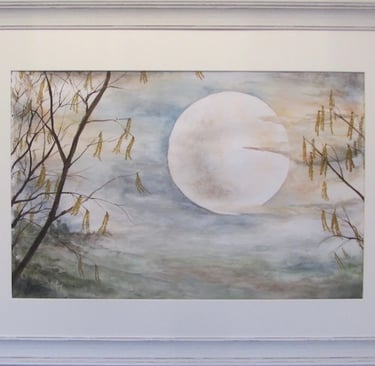
This year I have started to create a series of paintings depicting the full moons with their traditional folklore names. There are 12 of them, one for each month, but because moons don’t follow our Gregorian calendar, there are 13 moon cycles in each of our years. Thus, one month we get two new moons – the second of which is called a blue moon giving rise to the saying “Once in a blue moon”.


February's "Snow Moon" marking the end of winter, and March's "Worm Moon" celebrating the earth starting to warm up were both on exhibition - and sold! - at this year's Sefton Open at Southport's Atkinson gallery.
That would make a series of 13 moon paintings. Thirteen. Unlucky for some. Now I had the solution. Although it’s a solar eclipse, it’s the moon that is creating the eclipse by passing between the earth and the sun, so I could put my eclipse artwork into the moon collection and have a total of 14 in the series.
That immediately led me to think about doing it in watercolours to fit in with the other full moon paintings. However, to depict the drama of the eclipse it needed to be on a black background instead of the usual white paper.
Try painting watercolour on dark paper
Not surprisingly, watercolours do not react the same way on black paper as white . . . if you have never tried painting watercolours on a dark paper you should try it, it’s most strange. The paint seems to disappear or look so faint that you can’t see it, but leave it to dry and suddenly the picture emerges.
Not being 100% sure of how I was going to create the effects that would give me my artwork “Crowds gather in unison to watch the eclipse of the sun,” I started to experiment with some images on small A4 sheets of black paper.
For the shape of my eclipse image I decided to use one of my favourite parts of the phenomena, the ‘diamond ring’ as the sun first starts to emerge from the totality. Then, for the crowds gathering element, I wanted to add some figures stood at the bottom of the scene with just their outlines glinting in the first rays of the emerging sun.
Knowing how watercolours react on black paper and knowing that I wanted to create the effects of bright light, I decided to try using metallic watercolours instead of normal ones. They still went quite faint and for most of the time all I could see were some metallic glints floating around the page in the wet paint. That made it difficult to work out just how it was going to look and where it needed more paint. Then it dried and it came to life in its shiny splendour.


My first attempt at recreating the crowds watching the solar eclipse, this one in metallic watercolours.
It had some nice qualities that I was happy with but I knew that this was not the final answer. I liked the figures at the bottom but they were also too heavily outlined. That was partly because of the quick, sketchy way I was doing them, and partly because of the small size of the paper, but mostly because the medium didn’t allow me to control what the finished effect was going to look like.
As much as I used a wet-on-wet technique when doing the light radiating out from the sun it still gave a harsher edge than I wanted and as the eclipsed sun is the most important part of the painting, that part had to be spot on.
I considered doing another trial piece in normal watercolours, but that lack of control and inability to see the image until it had dried was still going to happen. There had to be another avenue to go down.
It’s at times like this that I am delighted that I have never taken the advice I have heard in so many art webinars that tell you in order to be a “proper” artist that you must niche down and specialise in only one medium and one subject genre. Lawd how dull and boring would that be!! I’m so glad that in their books I am not a “proper” artist because it means that I have a whole raft of media and genre to draw upon to be able to create whatever idea is in either my head or the heads of my commissioning patrons.
This time it was my ideas that I wanted to turn into reality, but I still had my favourite patron to thank for the easy solution. In the afternoon before the eclipse I had run a workshop with my tutored students teaching them about doing night-time scenes on dark paper with soft pastels, and it was one of her photographs that I had used.
I had shown them how soft pastels can be used to create the effects of lights by blending them out from solid, bright colours getting fainter and fainter until they disappear and all without leaving the hard edges that the watercolours had done. It was the obvious medium to try next.


My second A4-size attempt at recreating the crowds watching the solar eclipse, this one in soft pastel
I still did a small A4 size picture and this time I chose to do the full eclipse rather than the diamond ring section. I added figures in at the bottom but decided to leave off the groundline and background mountains that I had done in the watercolour version.
Looking at the finished trial piece I knew that this was the right medium to do the finished picture to go into my 14 moon series even if it is, technically, a drawing not a painting and is a new moon not a full moon.
There were still tweaks to bring to the finished picture compared to the preliminary one. For a start, to fit into the moon series it had to turn from portrait shape to landscape. That meant being careful with the proximity of the crowds and the moon. The portrait shape had given me a much greater depth within which to put the figures.
I worked on the same compositional lines as the other full moon paintings in regard to the placement of the moon: on the junction between the right vertical third and the top horizontal third lines. I then placed the figures in a flattened out U-shape encircling the lower half of the moon. In the other moon paintings some aspects of the foreground elements usually reach up and across the face of the moon, but I did not want anything to interfere with the dramatic glowing ring of fire in this picture.
I also knew that I needed the sun to be the dominant element in the picture yet the crowds were going to be drawn in using exactly the same colour soft pastel as I was using for the sun. To achieve the result I wanted I needed to do two things. First, the outlines of the figures had to be finely drawn to only show a sort of halo effect to the figures as they were backlit by the eclipsed sun. Secondly, the pastel had to be applied in a softer way than the main ring of the eclipsed sun so that it did not have the same depth of colour.


Get in touch
Use the message box to drop me a line if you want to:
purchase my paintings or drawings;
discuss commissioning me to create a unique work of art especially for you;
have a question to be answered in a future Picture Perfect blog post;
join one of my face-to-face painting or drawing classes in West Lancashire or have private coaching online;
discuss a bespoke staff development event using art to encourage teamwork and leadership
Contacts
0044 77242 00779
youcandrawandpaint@gmail.com